


How AI Delivers Real-Time Feedback in Immersive Training
The world of professional development is evolving, and Artificial Intelligence is playing a growing role in how we deliver, measure, and improve training. From real-time coaching feedback to predictive analytics and personalised learning paths, AI is reshaping what’s possible in corporate learning.
But what does AI training feedback in training actually look like? And how does it change outcomes for learners and organisations?
Let’s break down how AI fits into modern training, where it’s headed, and what it means for L&D professionals.
What AI feedback in training actually looks like
AI in training doesn’t mean replacing facilitators with robots, it means enhancing the learning process through data-driven insights, real-time response, and intelligent systems.
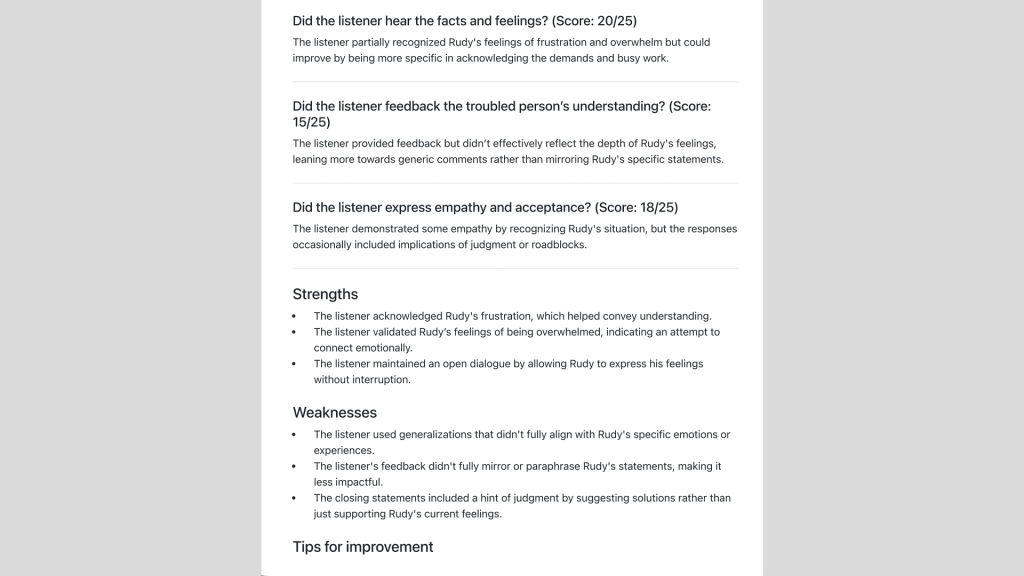
Here’s what’s possible today:
Real-time conversation analysis. During immersive training simulations, AI listens to what learners say—not just the words, but tone, pacing, and patterns. It can identify when someone is rushing, hesitating, or using ineffective communication approaches.
Behaviour tracking. AI tracks decisions made at key moments: Did the learner interrupt? Did they acknowledge the other person’s feelings? Did they escalate or de-escalate? These behavioural markers become data points for assessment.
Instant feedback. Rather than waiting for a debrief session, AI can provide immediate insights after each interaction. Learners see what they did well and what they could improve—while the experience is still fresh.
Pattern recognition across sessions. AI doesn’t just evaluate single interactions. It tracks patterns over time, identifying persistent habits, measuring improvement, and spotting skill gaps that might not be obvious in any single session.
Personalised recommendations. Based on performance data, AI can suggest specific areas to focus on, recommend additional practice scenarios, or adjust difficulty levels to match the learner’s development stage.
Beyond chatbots: AI as a training analyst
When people hear “AI in training,” they often think of chatbots—simple Q&A tools that answer employee questions. That’s useful, but it’s just the surface.
The real power of AI in immersive training lies in its role as an analyst and coach:
AI as observer. During a simulation, AI watches everything: word choice, response timing, emotional tone, decision patterns. It captures data that would be impossible for a human observer to track consistently across thousands of training sessions.
AI as evaluator. Using frameworks aligned with your training objectives—whether that’s active listening principles, de-escalation techniques, or leadership communication standards—AI evaluates performance against defined criteria.
AI as coach. Based on evaluation, AI provides targeted feedback: “You interrupted twice during the first minute. Try pausing for three seconds after the other person finishes speaking before responding.”
AI as reporter. For managers and L&D teams, AI aggregates data across learners, identifying organisation-wide trends, common skill gaps, and training effectiveness metrics.
This isn’t AI replacing human judgment—it’s AI handling the data-intensive observation and analysis work, freeing facilitators to focus on high-value coaching and support.
Real-time tracking: decisions, confidence, patterns
What exactly can AI track during an immersive training session? More than you might expect:
Decision tracking
- Which response options did the learner choose at key moments?
- How long did they take to respond?
- Did they change direction mid-conversation?
Communication patterns
- How often did they interrupt vs. allow the other person to finish?
- Did they use reflective listening techniques?
- What percentage of the conversation did they dominate vs. share?
Emotional indicators
- Did their tone match the situation appropriately?
- Did they escalate or de-escalate tension?
- How did they respond to emotional cues from the AI character?
Skill application
- Did they apply the techniques they were trained on?
- Which frameworks did they use effectively vs. struggle with?
- How consistent were they across different scenario types?
This granular data transforms soft skills—traditionally considered unmeasurable—into trackable, improvable competencies.
Personalised learning paths based on performance
One-size-fits-all training doesn’t work. People enter programmes with different skill levels, learning styles, and development needs. AI enables true personalisation:
Adaptive difficulty. If a learner handles basic scenarios easily, AI can increase complexity automatically—adding time pressure, more challenging personalities, or higher-stakes contexts. If they struggle, AI can dial back difficulty to build foundational skills first.
Targeted practice. Rather than repeating entire modules, learners can focus on specific skill gaps. Someone who excels at empathy but struggles with assertiveness gets more assertiveness scenarios. Someone who handles calm situations well but falls apart under pressure gets more high-pressure practice.
Spaced repetition. AI can schedule follow-up practice at optimal intervals, reinforcing skills before they fade and ensuring long-term retention rather than temporary performance.
Progress milestones. Clear markers show learners where they are in their development journey, what they’ve mastered, and what’s next. This visibility drives motivation and self-directed improvement.
Dashboards for learners and managers
Data is only valuable if it’s accessible and actionable. AI-powered training systems typically provide dashboards for different stakeholders:
Learner dashboards show:
- Performance scores across different skill areas
- Progress over time (improvement trends)
- Specific feedback from recent sessions
- Recommended focus areas and next steps
- Comparison to benchmarks (optional—some learners find this motivating)
Manager dashboards show:
- Team-wide performance overview
- Individual progress tracking for direct reports
- Common skill gaps across the team
- Training completion and engagement metrics
- ROI indicators linking training to performance outcomes
L&D dashboards show:
- Programme effectiveness across the organisation
- Content performance (which scenarios drive the most improvement)
- Cohort comparisons and trends over time
- Resource allocation insights (where to invest more training focus)
For the first time, soft skills development becomes as measurable as technical training—with clear data to justify investment and guide continuous improvement.
The human-AI partnership in training
The goal of AI in training is not to remove human connection—it’s to augment the facilitator’s ability to develop people by offering tools that save time, increase insight, and scale what would otherwise be impossible.
Think of it as a coaching partnership:
AI handles: Data collection, pattern recognition, consistent evaluation, instant feedback, progress tracking, and administrative reporting.
Humans handle: Contextual judgment, emotional support, complex coaching conversations, programme design, and relationship building.
Together they deliver: Personalised, scalable, measurable training that neither could achieve alone.
This partnership allows facilitators to spend less time on manual observation and documentation, and more time on high-value interventions where human expertise matters most.
Ethical considerations: privacy, transparency, and trust
As AI becomes more embedded in training, organisations must navigate important considerations:
Data privacy. Training data—including recorded conversations and performance assessments—must be protected, encrypted, and handled with clear policies about access and retention.
Transparency. Learners should understand how AI is evaluating them, what data is being collected, and how it will be used. Black-box assessment erodes trust.
Bias awareness. AI models can inherit biases from their training data. Regular auditing ensures evaluation criteria are fair across different communication styles, accents, and cultural backgrounds.
Human oversight. AI should inform human decisions, not replace human judgment entirely. Final assessments of capability should involve human review, especially for high-stakes evaluations.
Psychological safety. Learners need to feel safe to fail and experiment. AI feedback should be developmental, not punitive—supporting growth rather than surveillance.
Organisations that address these considerations proactively build trust in AI-enhanced training rather than resistance to it.
The Many Worlds approach to AI feedback
At Many Worlds, we blend immersive environments with AI-driven feedback to create training that’s both experiential and measurable.
Our approach includes:
Emotionally responsive AI characters that adapt in real-time based on learner behaviour—creating authentic practice, not scripted interactions.
Behavioural analysis that tracks communication patterns, decision-making, and skill application throughout each session.
Instant post-session reports that give learners immediate, actionable feedback while the experience is fresh.
Manager dashboards that visualise team progress and identify development priorities without requiring manual observation.
Continuous improvement data that helps L&D teams refine training content based on what actually drives skill development.
This hybrid model allows facilitators to maintain the human core of professional development while leveraging AI to scale impact, personalise learning, and prove outcomes.
The future of training feedback
AI isn’t the end of human-centred training—it’s the beginning of a new chapter. A chapter where technology supports deeper skill development, broader access, and more effective learning for everyone.
The organisations that embrace AI-enhanced training now will build capabilities their competitors can’t match: faster skill development, better measurement, and continuous improvement driven by real data rather than assumptions.
Ready to see AI feedback in action?
Experience how AI-powered feedback transforms soft skills training from guesswork into measurable development.
Watch our demos to see real-time AI feedback during immersive simulations, or get in touch to discuss how Many Worlds can bring AI-enhanced training to your organisation.
Frequently Asked Questions
How does AI measure soft skills? AI analyses multiple dimensions of communication: what you say (word choice, structure, clarity), how you say it (tone, pace, confidence), and how you respond to others (listening cues, empathy indicators, interruption patterns). By tracking these across multiple practice sessions, AI can identify patterns and measure improvement over time.
What feedback do learners get after VR training? Learners receive immediate feedback after each session: what they did well, specific moments that could improve, and concrete suggestions for their next attempt. Dashboards show progress over time, communication patterns, and comparison against benchmarks. Managers can access aggregated data to track team development.
Is AI feedback as good as human feedback? AI feedback is more consistent, immediate, and scalable than human feedback. It catches patterns humans miss and provides feedback without social awkwardness. However, AI works best alongside human coaching—AI handles the repetitive practice and data, while human facilitators provide context, encouragement, and nuanced guidance.
Can AI detect emotion in VR training? To a certain extent, yes. AI can analyse vocal tone, word choice, pacing, and hesitation patterns to infer emotional states. Combined with how learners respond to emotionally charged scenarios, this creates a picture of emotional regulation and empathy. This is particularly valuable for training active listening, conflict resolution, and leadership presence.
How do organisations measure VR training ROI? Effective measurement combines leading indicators (practice frequency, skill scores, confidence ratings) with lagging indicators (performance reviews, customer satisfaction, incident rates). AI analytics provide the leading indicators that traditional training lacks, making it possible to correlate practice with real-world outcomes.