

VR for Crisis Management Training: Training When the Stakes Are Real
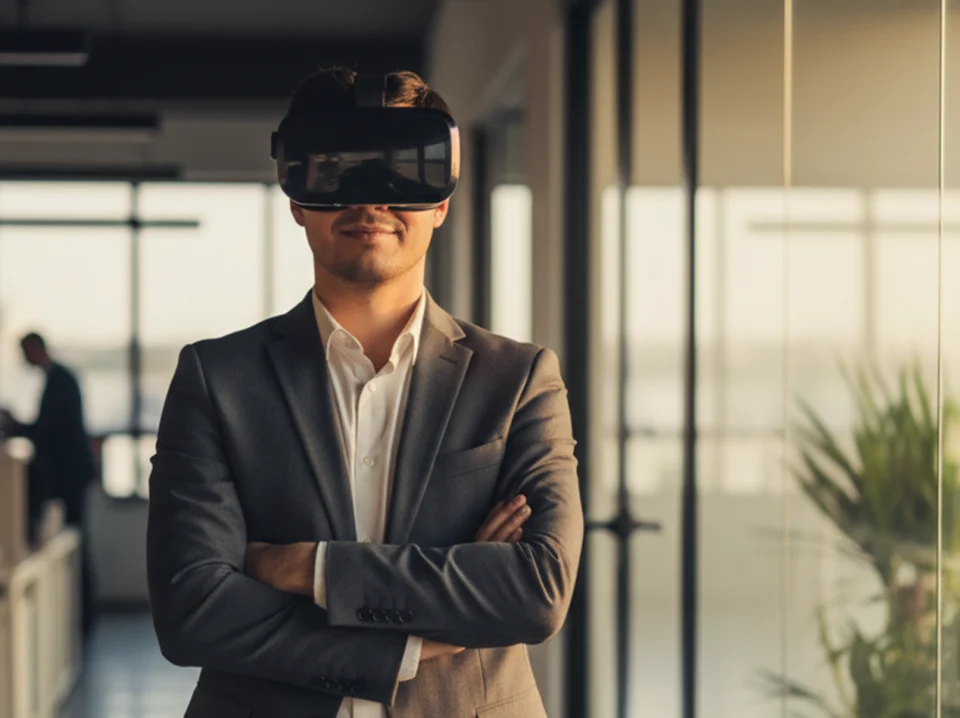
You might wonder: how exactly does virtual reality support high-stakes communication training? In truth, VR’s potential for developing crisis management, difficult conversation, and pressure-tested communication skills is vast—limited only by imagination.
The skills that matter most in critical moments—leading through crisis, de-escalating conflict, communicating under pressure—can only truly be learned through experience. But real life gives you one chance. Get it wrong, and there are real consequences: damaged relationships, lost clients, reputational harm, or worse.
What if professionals could practice these moments repeatedly, safely, until handling pressure becomes instinctive?
Why high-stakes communication is hard to train
Traditional approaches to crisis management training face fundamental limitations.
Classroom training can teach frameworks and theory, but knowing what to do and being able to do it under pressure are very different things. You can memorise de-escalation techniques, but that knowledge often evaporates when you’re facing an angry client or navigating a PR crisis in real-time.
Role-play exercises attempt to create practice opportunities, but they rarely feel real. Participants know it’s pretend. The emotional pressure is absent. And the quality depends entirely on whoever is playing the other role—often a colleague who’s equally uncomfortable and unprepared.
Live exercises can create realistic pressure, but they’re expensive, logistically complex, and impossible to repeat. You can’t run a full crisis simulation every time someone needs practice.
The result? Most professionals enter high-stakes situations having never truly practiced them. They’re learning on the job, where mistakes have real consequences.
Two approaches: simulation vs imagination
Training methodologies have historically relied on two main strategies for developing high-pressure skills:
In vivo training immerses a person in the actual environment or a realistic recreation of it. Think flight simulators for pilots, or live fire exercises for emergency responders. The realism creates genuine pressure and builds real capability.
Imaginal training asks people to visualise the scenario mentally. This is cheaper and more accessible, but effectiveness varies wildly. Not everyone can vividly picture a crisis scenario, and imagination alone rarely triggers the emotional responses that build genuine resilience.
The challenge for most organisations? True in vivo training for communication scenarios is impractical. You can’t manufacture a real PR crisis for practice. You can’t have a client actually threaten to pull a major contract just so a manager can rehearse their response.
And imaginal approaches—”picture yourself in a difficult conversation”—simply don’t create enough pressure to build real skill.
How VR bridges the gap
VR solves this fundamental problem by creating realistic immersive scenarios that feel real without being real.
With VR crisis management training, professionals can:
- Face an angry executive who threatens to pull a major contract—and practice de-escalation until it becomes instinctive
- Navigate a press conference with hostile journalists firing difficult questions—and rehearse staying composed under fire
- Deliver difficult news to a team member or client—and learn how different approaches land
- Handle escalating conflict between team members—and practice intervention techniques
- Respond to crisis scenarios specific to your industry—with realistic pressure and consequences
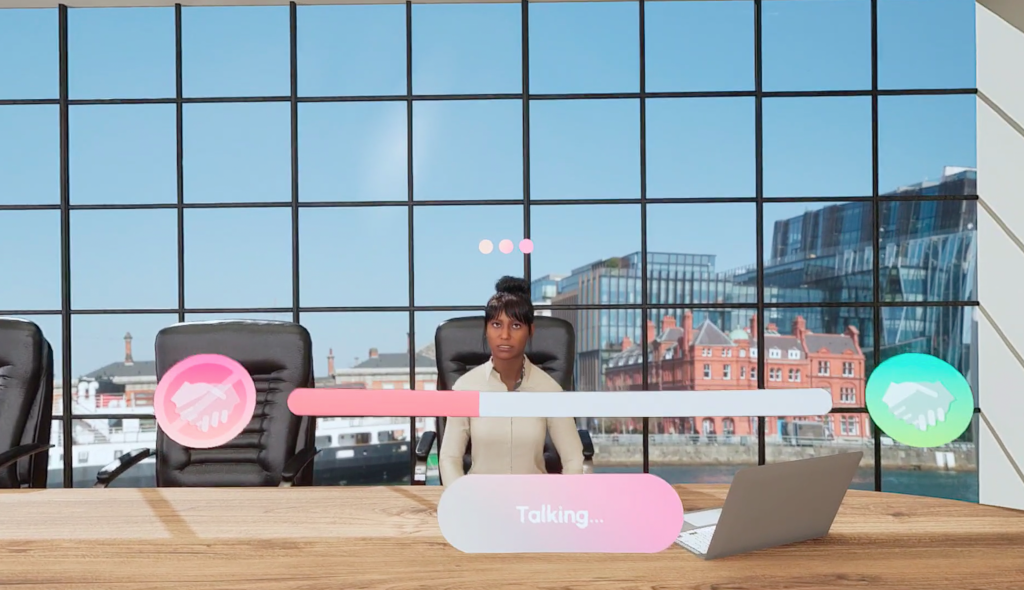
The key difference from role-play? The AI-powered characters respond authentically. They push back. They escalate if you handle things poorly. They disengage if you dismiss their concerns. The emotional pressure feels genuine because the responses are unpredictable and realistic.
And unlike one-off live exercises, VR scenarios can be repeated endlessly. Professionals can practice the same difficult conversation dozens of times, experimenting with different approaches, learning from failure without real-world consequences.
Customisable scenarios for your organisation
One of VR’s most powerful advantages is customisation. Scenarios can be tailored to match your specific context:
Industry-specific crises:
- Financial services: regulatory scrutiny, client complaints, market volatility communication
- Healthcare: patient family conversations, incident disclosure, media inquiries
- Professional services: project failure conversations, scope disputes, relationship recovery
- Technology: outage communication, security incident response, stakeholder management
Role-specific challenges:
- Executives: board presentations, investor relations, media interviews
- Managers: performance conversations, team conflict, change communication
- Client-facing staff: complaint handling, de-escalation, difficult requests
- HR professionals: disciplinary conversations, termination meetings, sensitive disclosures
Organisational scenarios:
- Your actual office environments recreated virtually
- Characters that match your typical stakeholders
- Scenarios based on real situations your teams face
This customisation means training feels relevant and immediately applicable—not generic exercises that participants struggle to connect to their actual work.
What makes VR crisis training effective
The effectiveness comes from several factors working together:
Presence creates pressure. When learners feel genuinely “there” in a realistic scenario, their stress responses activate. This isn’t a bug—it’s the feature. Learning to perform under pressure requires actually experiencing pressure during practice.
AI creates authenticity. Characters that listen and respond naturally create interactions that feel real. Learners can’t predict what the character will say next, so they must actually think and respond—not just follow a script.
Repetition builds skill. Unlike real crises (which you hope are rare), VR scenarios can be practiced repeatedly. This repetition is what transforms knowledge into instinct.
Safe failure accelerates learning. When failure has no real consequences, people take risks, try new approaches, and learn faster. They discover what works through experimentation rather than painful real-world lessons.
Data proves progress. AI-powered analytics track how learners respond across multiple sessions, showing measurable improvement in areas like response time, de-escalation effectiveness, and communication patterns.
Applications beyond crisis management
While crisis communication is a powerful use case, the same approach applies to any high-stakes interpersonal scenario:
- Active listening training: Practice truly hearing someone’s concerns without jumping to solutions or judgment
- Difficult feedback conversations: Rehearse delivering tough messages with clarity and empathy
- Negotiation skills: Practice high-stakes negotiations without risking real deals
- Interview preparation: Face realistic interviewers and refine your presence and responses
- Leadership presence: Practice commanding a room, handling pushback, and projecting confidence
Any scenario where the stakes are high and practice opportunities are limited becomes a candidate for VR simulation training.
The Many Worlds approach
At Many Worlds, we create immersive crisis management and communication training that feels real because the AI interactions are real conversations—not scripted role-plays.
Our simulations feature:
- AI-powered characters that listen, understand context, and respond naturally
- Behaviour-sensitive consequences where poor handling creates realistic breakdowns
- Customisable scenarios tailored to your industry and organisational context
- Real-time analytics that track skill development across sessions
- Platform flexibility across VR headsets, desktop, and mobile
We don’t just teach crisis communication theory. We give professionals a safe space to experience crisis pressure, make mistakes, learn from them, and build genuine capability—before the real crisis arrives.
Ready to practice the impossible?
The best crisis management training happens before the crisis. VR gives your team the opportunity to practice what they could never safely practice before.
Watch our demos to see high-stakes conversation training in action, or get in touch to discuss how Many Worlds can help your organisation build crisis-ready communication skills.