

Mining Supervisor soft skills training is crucial as only 17% of South African mining supervisors have the leadership competencies their roles require, and inadequate leadership contributes to over half of mining accidents. Traditional classroom training cannot close this gap because soft skills require practice, not theory. Immersive VR with conversational AI allows supervisors to rehearse difficult conversations in a safe environment, with research showing VR learners train 4x faster and are 275% more confident to apply skills.
Every day, thousands of shift bosses, mine overseers, and team leaders descend into South Africa’s mines carrying the weight of extraordinary responsibility. They’re accountable for production targets, equipment worth millions, and most importantly, the lives of their crews. Yet research reveals a troubling reality: the vast majority were never equipped to lead.
A 2025 study by OIM Consulting found that only 17% of front-line supervisors in South African mining possess the competencies required for their roles.
This isn’t a criticism of the individuals. It’s an indictment of a system that promotes people for technical excellence, then expects them to master an entirely different skill set, leading people, without meaningful support.
The Consequences Are Measured in Lives and Livelihoods
The soft skills gap isn’t an abstract HR concern. It shows up in incident reports, grievance files, and production data.
Research analysing 91 accidents at a South African platinum mine found that inadequate leadership was the most common systemic factor, present in over half of all accidents examined. A separate study from the University of Pretoria established that supervisor accountability is the single strongest predictor of safety behaviour. Stronger than safety climate or engagement programmes alone.
The pattern is clear: when supervisors lack the skills to communicate effectively, build trust, and hold meaningful conversations about safety, people get hurt.
Beyond safety, the productivity implications are significant. Gold Fields’ South Deep mine, after implementing a structured supervisor development programme with OIM Consulting, saw a 41% increase in gold production comparing the first and second halves of 2019, with overall productivity improving by 30% to 26.7 tonnes per employee, up from 20.5 tonnes per employee in 2018. The mine, which had a history of 11 years of losses, reported a profit at the end of the initial 12-month period. With labour representing one of mining’s largest cost categories, supervisor capability is a significant lever for operational improvement.
Why Technical Experts Struggle to Become People Leaders
The path to supervisor in South African mining typically runs through technical certification. A rock drill operator demonstrates competence, earns their blasting certificate, and eventually becomes a shift boss. The promotion recognises their technical mastery.
But the job they’re promoted into requires fundamentally different capabilities: reading emotional cues, adapting communication styles, having difficult conversations, building trust across cultural and language barriers, coaching rather than commanding.
Arjen de Bruin, Group CEO at OIM Consulting, captures the challenge: “Strong frontline leadership keeps mines running smoothly, yet too many supervisors are thrown into the deep end without being equipped with the skills they need to lead effectively.”
The South African context adds layers of complexity that supervisors elsewhere rarely face. With up to 11 languages spoken underground on some operations, safety-critical communication requires navigating significant linguistic diversity. Building trust between supervisors and crews takes deliberate effort in an environment where relationships have historically been transactional rather than collaborative. Supervisors must be skilled at constructive engagement and maintaining productive working relationships across different stakeholder groups.
These aren’t challenges that can be addressed through technical training. They require interpersonal skills that must be practised, not just understood.
The Classroom Cannot Teach What the Stope Demands
Here lies the fundamental problem: the skills supervisors most desperately need are precisely the skills that traditional training methods cannot develop.
Research consistently demonstrates that soft skills cannot be effectively learned through lectures, presentations, or e-learning modules. A study published in Frontiers in Psychology established that traditional learning environments provide declarative knowledge but do not enable learners to practice behavioural repertoires.
The numbers are stark. The Learning Pyramid shows lecture-based learning achieves just 5% retention, while practice-based learning achieves 75%. Additional research indicates that hearing-only retention drops from 70% after three hours to just 10% after three days.
You cannot learn to have a difficult conversation about fatigue by watching a PowerPoint. You cannot develop the instinct to de-escalate a tense safety intervention by reading a manual. You cannot build cross-cultural trust by completing an e-learning module.
South African mining compounds these limitations with practical barriers: 24/7 shift operations that conflict with training schedules, underground access limitations, fatigue from 12-hour shifts, and literacy levels that mean many workers cannot engage with text-heavy training materials. The Minerals Council has acknowledged that “a legacy of poor educational opportunities… have resulted in many employees having little or low levels of skills development.”
Traditional classroom training requires taking workers off production, transporting them to training centres, and assuming literacy and language proficiency that many workers simply don’t possess.
A Different Approach: Learning by Doing
If soft skills require practice, the question becomes: how do you create safe spaces for supervisors to practise difficult conversations before they face them underground?
Immersive technology offers a compelling answer.
The Mandela Mining Precinct’s SATCAP programme has been researching training technology applications for South African mining, including VR facilities at the Wits Mining Institute, University of Pretoria, and University of Johannesburg. Anglo American Platinum operates a world-first virtual stope at Amandelbult that allows miners to experience consequences of errors without physical risk.
A landmark PwC study comparing classroom, e-learning, and VR training for soft skills found dramatic differences. VR learners trained four times faster than classroom learners and were 275% more confident to apply skills afterward. They were nearly four times more emotionally connected to the content, a critical factor for behavioural change.
Mustak Ally, Head of Skills Development at Minerals Council South Africa, articulated the industry position: “Immersive technologies allow employees to learn in a safe environment fully immersed and interacting in real-time with information, equipment and hazards.”
But immersive technology for soft skills requires something beyond VR environments. It requires dynamic, responsive conversation partners who react authentically to how supervisors communicate.
This is where conversational AI changes the equation.
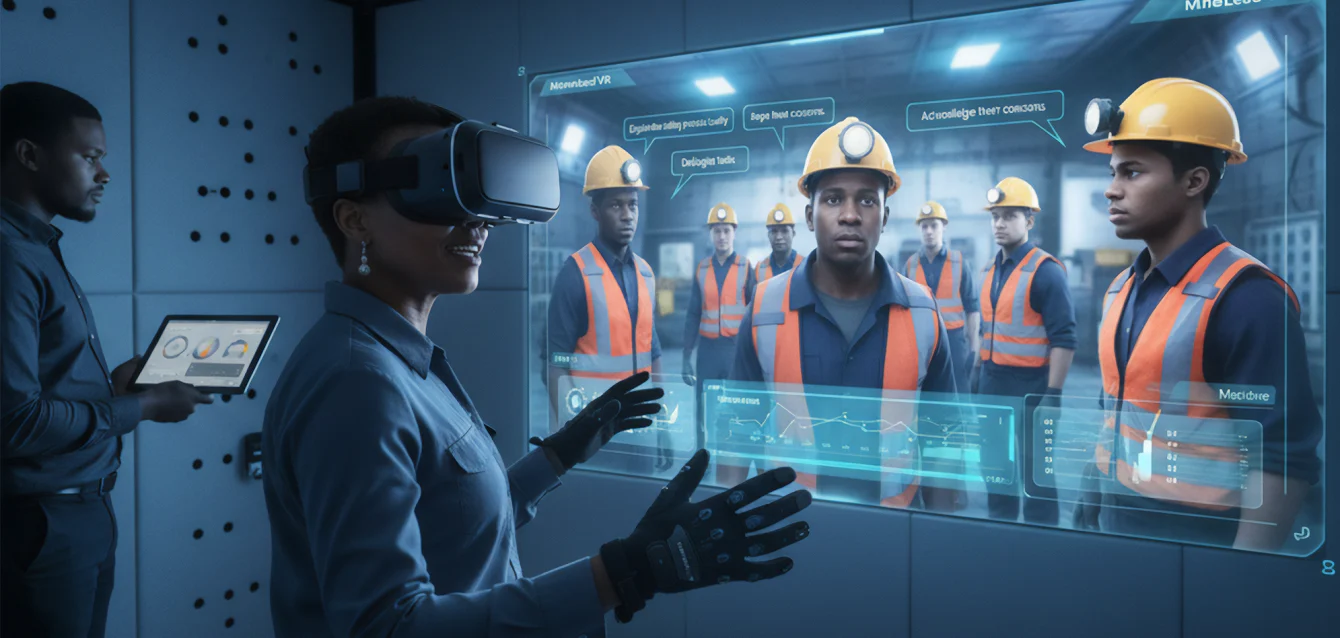
Imagine a supervisor practising a fatigue intervention conversation. The AI-powered worker responds differently based on approach: becoming defensive if accused, opening up if approached with empathy. The supervisor learns to read cues, adjust tone, and navigate resistance. They can fail safely, receive feedback, and try again.
This isn’t theoretical. Platforms combining VR and conversational AI are already being deployed for leadership training in other industries. Walmart trained employees across 4,700 stores using VR soft skills training, achieving 70% higher test scores and 10-15% higher knowledge retention than traditional methods.
Developing the Next Generation of Leaders
Many supervisors promoted for technical excellence arrive in leadership roles carrying a burden that training manuals don’t address: self-doubt. Research from The Business and Leadership Coaching Company reveals that professionals in these positions often feel “inadequate as effective managers,” expressing “a lack of confidence and competence in their ability to plan, lead, organize, and control a team effectively, despite their technical expertise.”
This isn’t a knowledge problem. It’s an experience problem. Confidence comes from having done something successfully, not from having read about it. A supervisor who has navigated a difficult conversation about fatigue ten times in simulation approaches the eleventh conversation, the real one, with earned confidence rather than theoretical preparation.
Immersive training with conversational AI provides exactly this: a judgement-free environment where supervisors can develop leadership competencies through practice, building the confidence that comes from experience rather than just knowledge.
Mining Supervisor Soft Skills Training
Picture a newly promoted shift boss preparing for their first difficult conversation. Perhaps addressing a safety concern with a veteran worker who has been mining longer than they’ve been alive.
In today’s system, that supervisor enters the conversation with theoretical knowledge at best. They’ve perhaps seen a video, attended a workshop, read a guideline. When the conversation goes sideways such as when the worker becomes defensive, when cultural dynamics complicate communication, when the union steward appears, they’re improvising in high stakes.
In an immersive training model, that same supervisor has already had versions of this conversation dozens of times. They’ve experienced how different approaches land. They’ve felt the emotional weight of getting it wrong and the satisfaction of getting it right. They’ve received specific feedback on their communication patterns.
When they face the real conversation underground, it’s not their first time. It’s their thirty-first.
This is what effective leadership development looks like: not knowledge transfer, but capability building through deliberate practice.
Closing the Gap
South Africa’s mining industry has achieved remarkable safety improvements. 2024 recorded the lowest fatality count ever, but 42 deaths remain 42 too many, and research confirms that supervisor capability is the single strongest lever for further improvement.
The soft skills gap is documented, consequential, and solvable. What it requires is acknowledging that leadership is a practiced skill, not an innate trait or a knowledge set. It requires training methods that match how adults actually develop behavioural capabilities. And it requires technology that creates safe spaces for the kind of practice that transforms technical experts into confident leaders.
The supervisors descending into South Africa’s mines tomorrow deserve to be equipped for the full scope of their responsibility, not just the technical aspects, but the profoundly human work of leading people through challenging, high-stakes environments.
The question for mining companies isn’t whether to invest in leadership development, but whether that investment will go toward training approaches that research shows don’t work, or toward modern methods that actually build the capabilities supervisors need.
What Comes Next
At Many Worlds, we’ve been developing immersive training applications that use conversational AI to help professionals practice high-stakes interpersonal skills. Our trainees don’t click through branching dialogues or select from multiple-choice responses. They speak naturally to AI characters who listen, respond dynamically, and adapt based on how the conversation unfolds.
We’ve seen the impact of this approach in crisis management training, where leaders must make rapid decisions while communicating under pressure. We’ve seen it in active listening simulations, where the difference between a good outcome and a poor one hinges on tone, timing, and the ability to read emotional cues. These are precisely the skills that determine whether a supervisor can intervene effectively on fatigue, navigate a tense safety conversation, or build the trust that transforms a crew into a team.
We believe this technology has a significant role to play in developing the next generation of mining leaders.
If you want to explore what immersive conversational training could look like for your operation, we’d welcome the conversation.