

From Impersonal Tools to Human-Centered Catalysts
The common view of Virtual Reality and Artificial Intelligence as detached, unfeeling technologies is understandable, but it misses their true potential.
Instead of being emotionless substitutes for human interaction, VR AI human training technologies are emerging as powerful tools that enhance our most human-centric processes, especially when our own limitations fall short.
This isn’t about technology replacing people. It’s about technology empowering them.
Filling the gaps in human interaction
Think about a typical recruitment process. Days pass with no word back, and you feel like a single line of text on a CV, not a person. This experience isn’t caused by a lack of empathy from recruiters, but often by an overwhelming workload.
The same pattern appears across professional contexts:
- Managers who want to give feedback but don’t have time to coach every team member individually
- Trainers who can’t possibly observe and debrief every learner in a large cohort
- Leaders who understand the importance of difficult conversations but keep postponing them
- HR teams drowning in process who can’t provide the personalised support employees need
This is where AI and VR can fill a critical gap.
AI isn’t just for automating tasks—it can be a supportive, responsive tool that provides consistent engagement when a human simply can’t be there. In training contexts, this translates to AI-powered simulations that provide unlimited practice opportunities, instant feedback, and patient repetition that no human facilitator could sustain at scale.
VR creates the environment. AI creates the responsiveness. Together, they fill gaps that human limitations create—not because humans don’t care, but because there are only so many hours in the day.
Creating authentic experiences
VR goes a step further, providing a level of authenticity that traditional approaches simply cannot match.
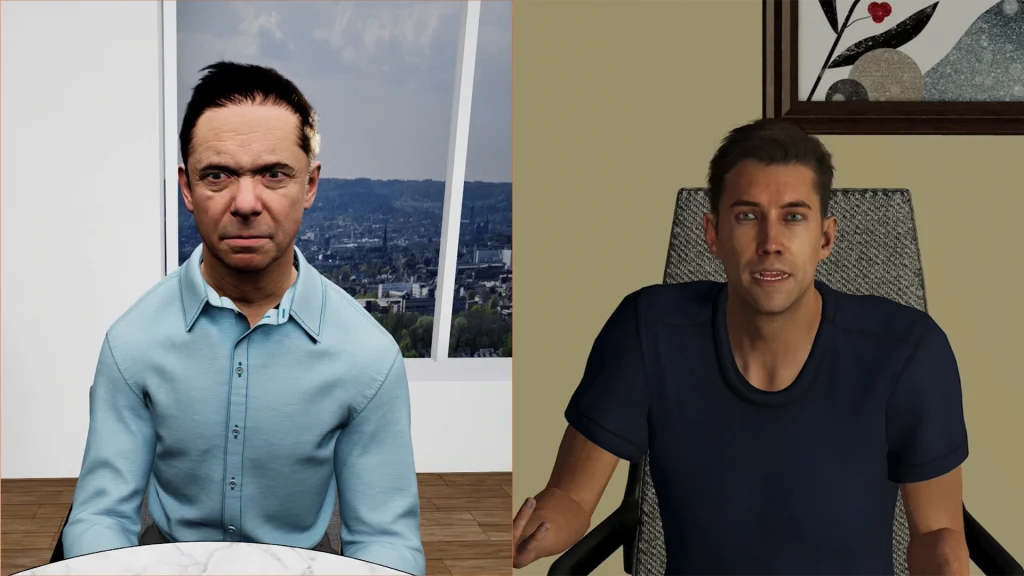
In soft skills training, VR simulations allow you to step into realistic scenarios, fostering genuine emotional responses and teaching you how to navigate difficult conversations in a safe, risk-free environment.
Research from Stanford University has shown that VR training can increase emotional and personal expression—people become more themselves, not less, when practicing in virtual environments. The removal of real-world consequences paradoxically creates more authentic behaviour.
This matters because soft skills are fundamentally about authentic human interaction. You can’t learn empathy from a textbook. You can’t develop leadership presence from a video. You need to practice, feel the pressure, make mistakes, and try again.
VR provides that practice space. AI provides the responsive partner. Together, they create experiences that feel real enough to trigger genuine learning.
Realistic previews and skills-based assessment
Beyond training, VR and AI enable new approaches to talent development and assessment:
Realistic job previews allow candidates or new hires to experience a workplace firsthand before they fully commit. What’s it actually like to handle an angry customer in this role? What does a typical high-pressure day feel like? VR can show them rather than tell them.
Skills-based assessment moves beyond words on a CV to evaluate actual capabilities. Rather than asking “tell me about a time you handled conflict,” you can observe how someone actually handles conflict in a realistic simulation.
Onboarding acceleration immerses new team members in scenarios they’ll face, building capability faster than shadowing or documentation ever could.
This approach helps ensure that talent—not just credentials or interview performance—becomes the focus.
The new paradigm of augmented humanity
The true power of VR and AI lies not in replacing humans, but in augmenting our capabilities.
By automating data-heavy tasks—observation, pattern tracking, consistent feedback delivery—AI frees us to focus on the high-value, relational work that requires empathy, creativity, and ethical judgment.
This partnership changes what’s possible:
For trainers and facilitators: Spend less time on manual observation and documentation. Spend more time on meaningful coaching conversations with learners who need human guidance.
For managers: Provide every team member with unlimited practice opportunities for difficult conversations, without requiring hours of your personal time for each one.
For learners: Get patient, non-judgmental practice partners who never tire, never lose patience, and never make you feel embarrassed for needing repetition.
For organisations: Scale personalised development in ways that would be financially impossible with purely human-delivered training.
The goal isn’t to trade human connection for technology. It’s to use technology as a catalyst for a more connected, efficient, and effective approach to professional development.
Addressing the skepticism
Let’s be honest about the concerns people have:
“AI can’t understand human emotion.” Current AI can’t feel emotion, but it can recognise patterns in communication and respond appropriately. For training purposes, what matters is whether the interaction creates a useful learning experience—and it does.
“VR is isolating.” Poorly designed VR can be isolating. Well-designed VR creates shared experiences that become conversation starters. Teams who go through VR training together often report stronger connections, not weaker ones.
“Technology makes things less personal.” Only if implemented badly. When technology handles the scalable, repetitive elements well, it creates more space for genuinely personal human interaction where it matters most.
“This is just a way to cut training budgets.” It can be—but the better use case is doing more with the same budget. Reaching more people, providing more practice opportunities, and measuring outcomes that previously couldn’t be measured.
The skepticism is healthy. The answer isn’t blind technology adoption—it’s thoughtful implementation that keeps human development at the centre.
At Many Worlds
We believe the future isn’t about technology replacing people. It’s about technology empowering them.
We design bespoke VR environments with conversational AI to achieve a new paradigm of augmented humanity. Our solutions go beyond standard training by creating deeply immersive experiences that build empathy, refine soft skills, and foster genuine capability.
By handling the repetitive and logistical aspects of skill practice, our AI allows your team to focus on what truly matters: strategic thinking, creative problem-solving, and meaningful human interaction.
It’s time to transform your training from a transactional process into a truly human-centered journey.
Ready to see augmented humanity in action?
Experience how VR and AI can enhance—not replace—human development in your organisation.
Watch our demos to see human-centered AI training in practice, or get in touch to discuss how Many Worlds can support your team’s growth.