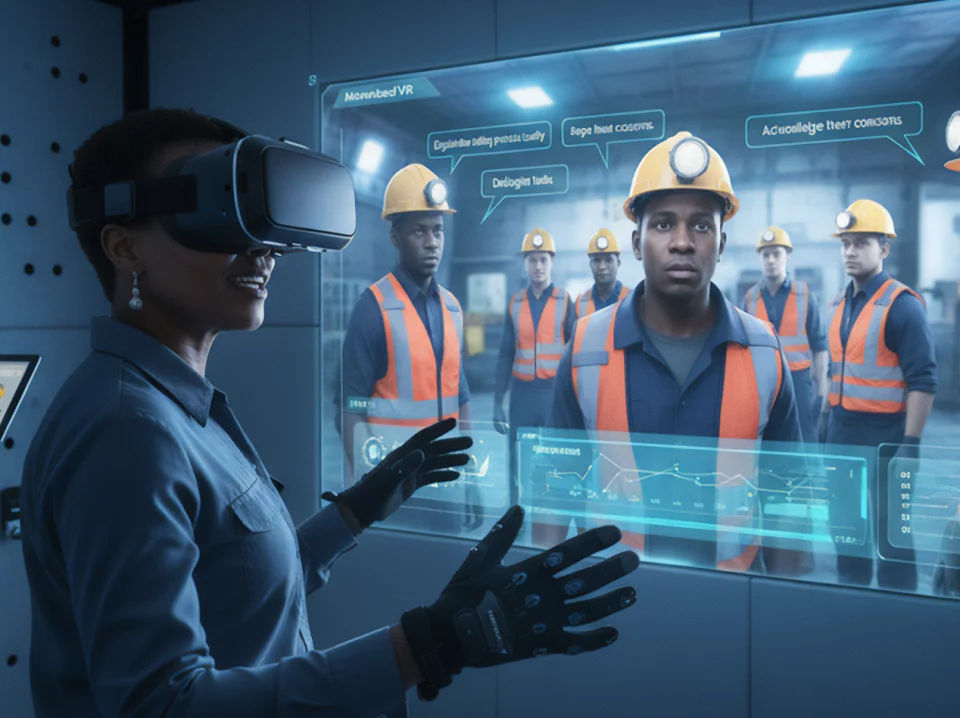


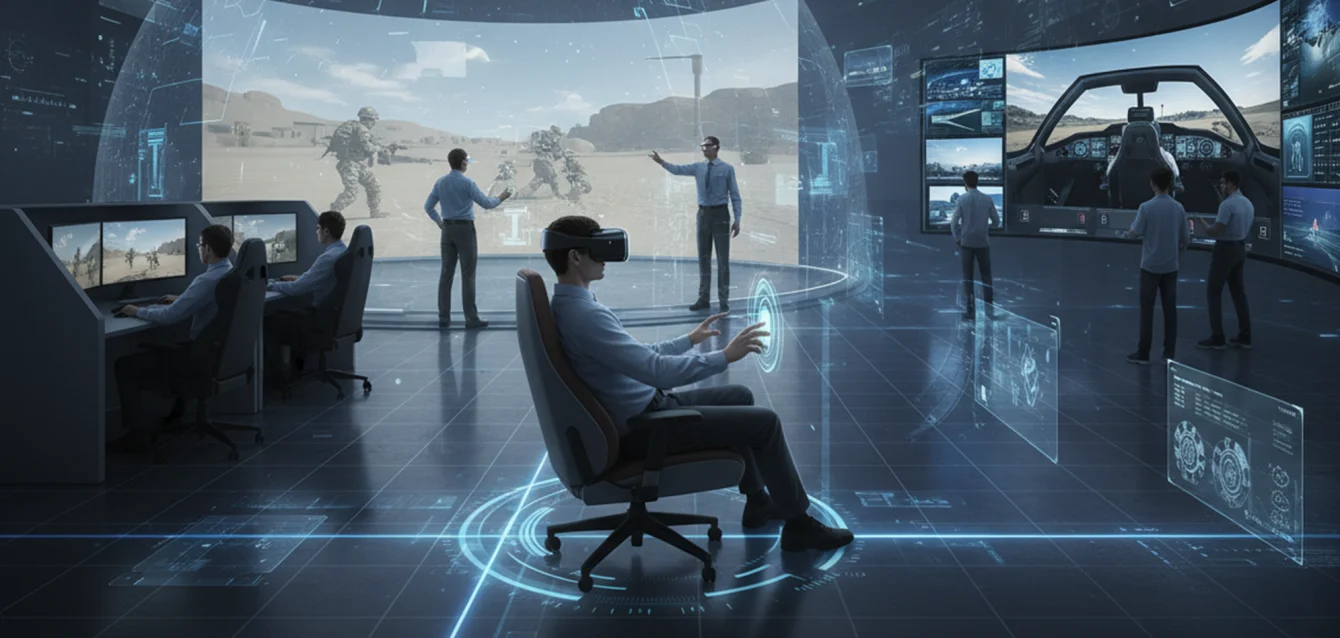
VR without a headset is possible. What makes VR training effective isn’t the hardware, it’s presence, the psychological feeling of “being there.” Headsets are one way to create presence, but projection systems, simulators, and well-designed screen-based experiences can achieve it too. Headsets add the most value when training requires spatial awareness or physical embodiment. For soft skills like communication and leadership, the quality of AI characters often matters more than the display technology.
When most people think of immersive training, they picture someone wearing a headset, controllers in hand, completely cut off from the outside world.
It’s a reasonable assumption. Headsets have become synonymous with virtual reality. But here’s what the research actually shows: the headset isn’t what makes immersive experiences work. It’s just one way to achieve the psychological state that does.
That state is called presence. And understanding the difference between the technology and the psychology changes how you should think about immersive training for your organisation.
The Misconception: Confusing the Tool for the Outcome
There’s a common confusion in the VR industry between two related but distinct concepts: immersion and presence.
Immersion is a property of the technology. It describes a system’s ability to simulate reality with high fidelity. The resolution of the display, the quality of the audio, the responsiveness of the tracking. Immersion is objective. You can measure it. A higher-resolution headset is more immersive than a lower-resolution one.
Presence is a property of the user’s mind. It’s the subjective feeling of “being there”. The sense that you’re actually inside the environment, not just looking at a screen. Presence is psychological. Two people can use the same system and experience very different levels of presence.
Here’s why this matters: presence is what drives learning outcomes. When someone feels genuinely present in a training scenario, their brain responds as if the situation were real. Stress hormones activate. Emotional memories form. Skills transfer to the real world.
The headset is one tool for creating presence. But it’s not the only one.
What Research Shows About Presence
A study on VR-assisted psychotherapy found that virtual environments could induce genuine emotional and physiological responses. The same responses that would occur in real situations. Participants reported authentic emotions, and recalled personal memories triggered by the virtual stimuli.
What made this work wasn’t the headset itself. It was the combination of factors that allowed participants to psychologically “enter” the virtual space:
- Visual isolation from the physical environment
- Focused attention on the simulated stimuli
- Reduced external distractions that would break the illusion
- Meaningful content that engaged them emotionally
The headset achieved this by physically blocking peripheral vision and replacing the visual field entirely. But the researchers noted that the headset could also be a hindrance (i.e. discomfort, weight, and technical issues) which sometimes pulled participants out of the experience.
The takeaway: technology that increases immersion doesn’t automatically increase presence. Sometimes it does the opposite.
Ways to Create Presence Without a Headset
If presence is the goal, what are the alternatives to headsets?
1. CAVE Systems (Projection-Based VR)
CAVE systems use multiple projectors to display images on the walls, floor, and sometimes ceiling of a room. Users wear lightweight 3D glasses and can move naturally within the space.
Advantages:
- No heavy headset
- Multiple people can share the experience
- Natural movement and social interaction
- Easier for extended sessions
Disadvantages:
- Expensive infrastructure
- Fixed location
- Lower visual isolation than headsets
CAVE systems have been used for decades in research, military training, and industrial applications. They’re particularly effective when collaboration matters or when learners need to move freely.
2. Large-Format Displays and Simulators
Flight simulators predate VR headsets by decades, and they work. A well-designed simulator with a large curved display, realistic controls, and appropriate motion cues can create powerful presence without fully enclosing the user.
This approach scales down too. A large monitor, quality headphones, and a thoughtfully designed scenario can create meaningful engagement for desktop-based training.
3. Narrative and Psychological Immersion
This is the least discussed but potentially most accessible path to presence: designing experiences that engage users so deeply that they forget they’re in a training environment.
Think of how a compelling film can make you forget you’re in a cinema. The screen doesn’t surround you. The sound isn’t spatial. But you’re emotionally present in the story.
Well-designed interactive scenarios, even on a standard screen, can achieve similar effects when they:
- Create genuine stakes and consequences
- Respond dynamically to user choices
- Feature believable characters and dialogue
- Build emotional investment
This is why AI-powered training characters matter so much. A photorealistic environment means nothing if the people in it feel robotic. A simple environment with characters that respond naturally can be far more engaging.
When You Actually Need a Headset
None of this means headsets are unnecessary. For certain training applications, they’re the clear choice.
You likely need a headset when:
- Embodiment matters. Training that requires looking around naturally, using your hands, or experiencing a specific physical perspective benefits from full VR. Think: safety walkthroughs, equipment familiarisation, spatial decision-making.
- Isolation is the point. When you need to remove all distractions and force complete focus, headsets do this better than any alternative. This is why they work well for exposure therapy and high-pressure scenario training.
- Scale and portability matter. A headset costs a fraction of a CAVE system and fits in a backpack. For organisations deploying training across multiple sites, standalone headsets are often the practical choice.
- The scenario requires looking around. If learners need to scan an environment, check behind them, or experience true spatial awareness, a 360-degree headset view is hard to replicate otherwise.
You might not need a headset when:
- Training is primarily conversational (difficult conversations, interviews, coaching)
- Multiple people need to train together in the same physical space
- Sessions are long and comfort is a concern
- Learners have accessibility needs that headsets don’t accommodate
- Budget constraints make headset deployment impractical
The honest answer is that it depends on your specific training challenge.
How to Decide What’s Right for Your Organisation
Rather than starting with “should we buy headsets?”, start with these questions:
1. What skill are we actually training?
If it’s a soft skill (communication, leadership, active listening) the value comes from realistic human interaction and feedback, not from looking around a 3D space. You might achieve excellent results with simpler technology.
If it’s a spatial or physical skill (navigating an environment, operating equipment, responding to visual cues from multiple directions) a headset adds genuine value.
2. What creates presence for this scenario?
For some scenarios, visual fidelity drives presence. For others, it’s the quality of the characters. For others still, it’s the stakes and consequences built into the narrative.
Invest in what actually matters for your use case.
3. What are the practical constraints?
Headsets require charging, cleaning, fitting, and technical support. They don’t work well for everyone. Some people experience motion sickness, others find them claustrophobic, and they’re challenging for users who wear glasses.
Screen-based solutions have their own limitations but often integrate more easily into existing workflows.
4. Can you test before you commit?
The best way to know whether headsets add value for your training is to compare. Run the same scenario with and without headsets. Measure engagement, learning outcomes, and practical factors like completion rates and learner feedback.
The Bottom Line
Headsets are a powerful tool for creating presence. But they’re not the only tool, and they’re not always the right tool.
What matters is whether your training creates the psychological state that drives learning: the feeling of being genuinely present in a situation that matters.
Sometimes that requires a headset. Sometimes a well-designed screen-based simulation achieves the same result at a fraction of the cost and complexity. Often, the quality of AI-powered characters and feedback matters more than the display technology.
The question isn’t “do we need VR?” It’s “what creates presence for the skills we’re training?”
Start there, and the technology decisions become much clearer.
See Both Approaches in Action
At Many Worlds, we build immersive training simulations that prioritise presence, regardless of the hardware. Whether you’re exploring headset-based VR or screen-based alternatives, we can help you understand what’s right for your training goals.
Watch our demo to see AI-powered training characters in action, or get in touch to discuss your specific needs.